

By Mr. Z
I learned more important lessons during my first few weeks in college than I did from the entire seven years I spent at the academies I attended: UIC, the University of Illinois and Columbia University. Even seasoned college professionals sometimes wonder how this can be possible.
My most important college lessons did not occur in classrooms, and they weren’t inspired by any assignments. I’m not trying to say coursework has no value, or that it isn’t the main purpose of college. But college is as much an informal experience as a set of organized courses, and the lessons of the experience can leave a lasting impact.
That is, if we heed them.
Lesson one: We only think we know what we want.
College was the first environment in my life that treated me like an adult. I heard this would happen, and I looked forward to it. After 18 years of dealing with adults, I believed I knew them well: they were free to go where they pleased and act how they wanted. But there was more to it. I’d learn wanting something and getting it were two different things.
This was 1991, and we registered for classes by filling out scantron sheets and loading them into a machine. On my first day, an advisor lady gave me a tome I should look through to find course codes I’d need to present to the registrar. Another tome listed the programs of study. Together, these books were the size of a cinderblock.
I brought them to the registration center: a dusty labyrinth of cork walls pinned up with sheets of paper. These were lists of closed courses. every single course I wanted was full. When I looked carefully at my documents, I realized I had misread dates; instead of coming on the first available registration date, I had come on the last.
I went back to the advisor lady who was eating soup. I asked her, “What should I do?”
She slurped, and her annoyed eyes peered over gold-rimmed reading glasses. “Fill out a schedule that keeps you full time. Then beg professors to admit you to classes you actually want. They might do it. They might not. After that, drop the courses you don’t need.”
“Isn’t there any way to just register for what I need today?”
“Young man,” she said, “you’re well advised to grow up.” Then she checked her watch. “And you should get to bursar before they close. You don’t want to miss that.”
Lesson two: High school is performance art.
I attended a Catholic High School whose sinful lie was to call itself college prep. I was an “honors” student, but while I was too much of a hellraiser to earn straight A’s, all the teachers said I was ready for college.
Yet here I was unable even to register properly. Registration took the entire first week, a dozen or more trips to the registration center. Once I had a schedule, I scrambled to get books.
One of my classes was Geography, a subject I thought I had memorized. All it required was to know the 50 states by heart and that The Sound of Music was not set in Australia. The books were an atlas, whose sections showed things like detailed elevations of neighborhoods in famous cities, and a textbook whose first chapter was about economics, politics and history. It was full of words I had never seen before.
Honors program? Shame!
College prep? Performance art!
I was about as prepared for my first week as a pail could be prepared to make water.
Lesson Three: Strangers aren’t strange
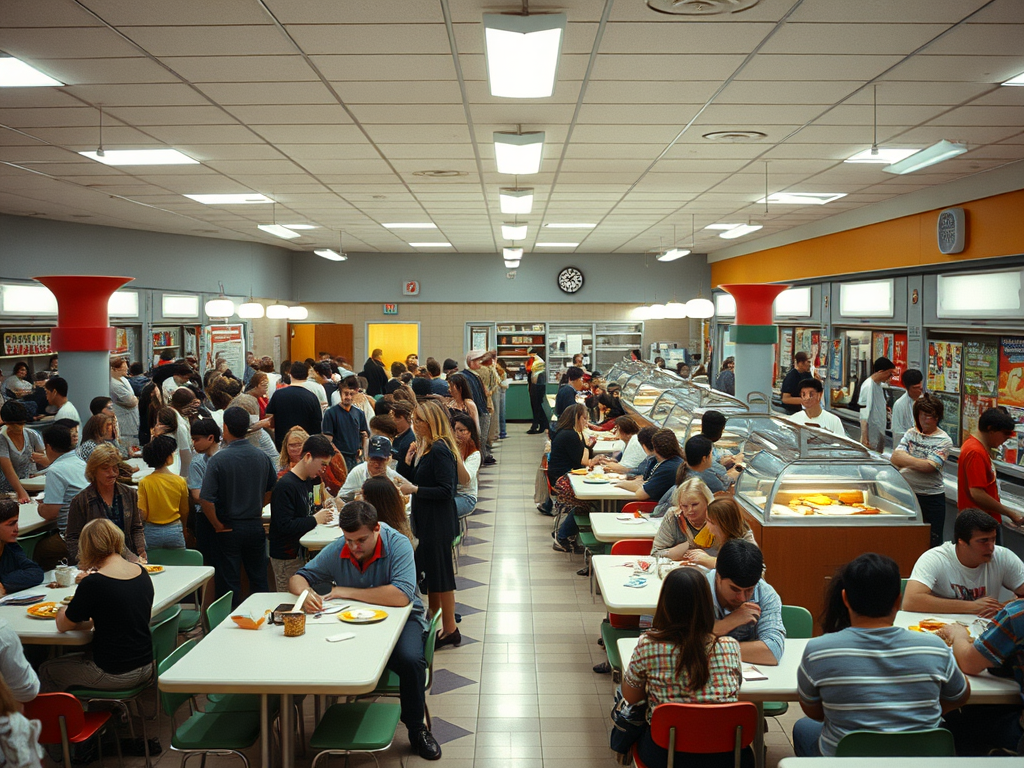
One afternoon, the cafeteria was packed. As I looked around for a seat, an older student—he might have been in his early 30s—gestured to a free spot at his table.
The guy was a Chicago cop pursuing a masters degree in political science. The others were all strangers to each other: an international student from China, another from India, one woman from Beverly, a hockey player from Milwaukee, then the cop and two women who learned just then that they both lived a few blocks from each other in Austin (the West Side, not Texas). I never would have sat with a group like this in high school.
Naturally, we started talking about travel and culture. Why would people from China and India want to study math and physics at UIC? Was it weirder to go to UIC if you were from Milwaukee or Beverly? You could live your whole life in Austin but never pass each other!
One of the things I loved about this new environment was the amount of fellow students who were older and had real jobs. I was the youngest at the table by at least 3 years. I felt like I was being mentored, and I learned I was not the only one to face registration issues, or to discover hard books.
College, it seemed, was designed to get all of us out of our comfort zones. And one comfortable way to do it was to sit at a table with people going through the same thing. It wasn’t strange at all, not when it was happening to everyone at the same time.
I thought I knew what I wanted but didn’t. The folks at the table felt the same. I thought I had been prepared but wasn’t. That was true for the others as well. And I had not come looking to sit at a table with people who’d otherwise be strangers. Yet there I was.
Getting used to it was fun. As was learning that your peers and experiences teach you as much or more than your courses do.
I loved the ending- so true!